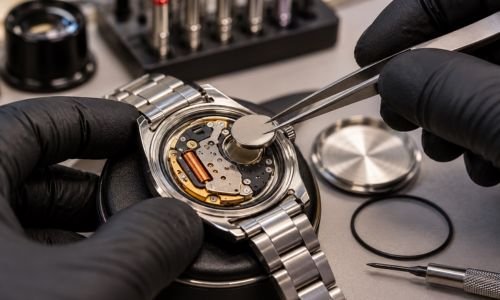
Water damaged watch repair London is something most owners only search for when something has already gone wrong. Perhaps the crystal has fogged up, the watch has stopped after swimming, or you have noticed droplets beneath the glass.
Whatever the circumstances, the most important thing is to act promptly.
At Dynamis Watch Service Piccadilly, we have worked with mechanical, automatic and quartz watches since 1994. From our workshop inside Piccadilly Circus Underground Station, we help customers across Central London identify watch faults and understand their repair options.
Here are seven warning signs of water damage, what you should do immediately, and what a professional inspection may involve.
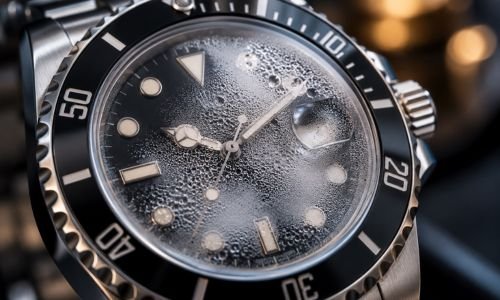
1. Condensation Appears Beneath the Watch Crystal
One of the clearest warning signs is mist or condensation on the inside of the watch glass.
It can look like a faint cloudy patch, particularly after moving between warm and cold environments. More serious cases may show visible droplets collecting beneath the crystal.
A brief change in appearance caused by temperature does not always establish how much water has entered the case. However, persistent internal condensation should never be ignored.
Moisture can affect the dial, hands, movement and electronic components even when the watch continues to operate.
What to do: Stop wearing the watch, keep it dry and arrange a professional inspection as soon as possible.
2. Your Watch Stops Working After Water Exposure
A watch that stops shortly after swimming, showering or exposure to heavy rain may have suffered water ingress.
In a mechanical watch, moisture can affect the balance assembly, escapement, gear train and other finely finished components.
In a quartz watch, water can interfere with the circuit board, battery contacts and electronic connections.
The watch may stop immediately, or it may continue running before developing problems later.
Do not assume that replacing the battery will solve the issue. If water has entered the case, the movement needs to be examined before the correct repair can be determined.
3. The Watch Starts Running Fast, Slow or Erratically
Water damage does not always stop a watch completely.
Sometimes the first indication is a change in timekeeping.
A mechanical watch may begin losing time because corrosion, contaminated lubricants or increased friction are affecting the movement.
A quartz watch might skip, stop intermittently or behave unpredictably if moisture has affected its electrical components.
These symptoms can also have unrelated causes, so a proper diagnosis matters.
If the timing problem began after water exposure, tell the watchmaker exactly when and how the watch became wet.
4. Rust or Discolouration Appears Around the Dial
Visible corrosion is a more concerning sign.
You might notice staining around the hands, dial markers or date window. In some cases, discolouration appears along the inner edge of the crystal.
Not every stain is caused by water, but rust-like marks following moisture exposure warrant inspection.
Inside a mechanical movement, corrosion can develop on steel components, screws, pivots and springs.
Even relatively small areas of damage may affect performance.
A professional assessment can establish whether components can be cleaned and preserved or whether replacement parts are necessary.
5. The Crown or Pushers Feel Unusual
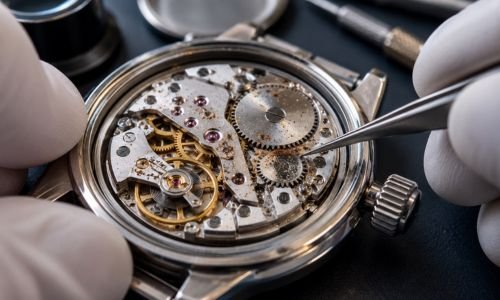
The winding crown and chronograph pushers are potential entry points for moisture.
Their sealing arrangements vary by watch design, but many rely on carefully fitted gaskets.
If a crown suddenly feels unusually stiff, gritty or difficult to operate following water exposure, do not force it.
Moisture or corrosion may be affecting the crown tube, stem or surrounding components.
The same applies to pushers that become difficult to press or fail to return normally.
Important: Do not pull out the crown or operate the pushers while the watch is wet. Doing so may allow additional moisture into the case.
6. Moisture Returns After the Watch Appears to Dry
A watch may look normal again after condensation disappears.
That does not necessarily mean the problem has been resolved.
Moisture can remain inside the movement or beneath components even after the crystal looks clear.
If fogging repeatedly returns, particularly after changes in temperature, the case’s water-resistant sealing system may be compromised.
Possible causes include deteriorated gaskets, damage to the crystal seal, a poorly seated case back or problems around the crown.
A professional inspection is needed to identify the actual cause.
7. The Watch Was Exposed to Salt Water
Salt-water exposure deserves particular attention.
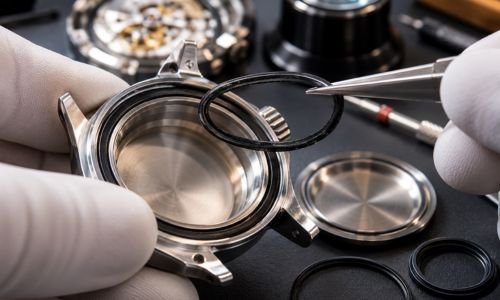
If seawater enters a watch, it can accelerate corrosion and leave conductive or corrosive deposits on delicate components.
A watch may initially continue running while damage develops internally.
Even a watch designed for swimming or diving can lose water resistance because of ageing seals, damage or previous servicing.
If you suspect seawater has entered the case, seek professional attention immediately rather than waiting for visible symptoms.
What to Do Immediately if Water Gets Inside Your Watch
The first few decisions matter.
You cannot reliably repair internal water damage at home, but you can avoid making the situation worse.
- Remove the watch from your wrist. Avoid further exposure to water, steam or humidity.
- Dry the exterior gently. Use a clean, soft cloth without applying heat.
- Do not operate the crown or pushers. Leave the controls alone, particularly while moisture remains.
- Do not shake or repeatedly wind the watch. Avoid unnecessary operation until it has been assessed.
- Do not open the case yourself. Improper opening can introduce dirt or damage the sealing surfaces.
- Arrange professional inspection promptly. Explain whether the exposure involved rain, fresh water, seawater or another liquid.
If the watch is valuable, vintage or sentimental, prompt assessment is especially important because replacement components may be expensive or difficult to source.
Why You Should Not Use a Hairdryer or Rice
Online advice sometimes recommends putting a wet watch in rice or using a hairdryer.
Neither method is a substitute for professional repair.
Rice cannot remove corrosion or reliably extract moisture trapped inside a sealed movement.
A hairdryer introduces another risk: excessive heat can damage seals, adhesives, dial finishes and other sensitive components.
Even if the crystal becomes clear, contamination may remain inside the case.
The appropriate solution is inspection, controlled drying or cleaning where necessary, and correction of the original sealing fault.
How Professional Water Damaged Watch Repair Works
Not every water-damaged watch requires the same work.
A watch exposed briefly to moisture may need a different intervention from one that has spent several days with water inside the movement.
At a professional workshop, the assessment may involve examining the case, movement, dial, crown, seals and evidence of corrosion.
Initial Inspection
The watchmaker first considers the symptoms and exposure history.
When did the watch get wet? Has it stopped? Is condensation visible? Was it exposed to salt water?
The condition of the crystal, case back, crown and pushers may provide clues about possible entry points.
Movement Assessment
Depending on the watch and the extent of damage, opening the case may be necessary.
The watchmaker can then examine the movement for moisture, corrosion, contamination and damaged components.
For a mechanical watch, this may include checking the balance, escapement, gear train and lubricated contact points.
For a quartz watch, the battery compartment, contacts and electronic circuitry require particular attention.
Cleaning, Repair and Servicing
If moisture has contaminated a mechanical movement, partial repair may not be sufficient.
A full service may be recommended where the movement requires disassembly, cleaning, inspection, lubrication, reassembly and regulation.
Corroded or damaged parts may need replacing.
Quartz movements may require electrical testing, contact cleaning or component replacement. In some cases, replacing the movement is more practical than repairing extensive electronic damage.
Gasket Replacement and Water-Resistance Testing
After the internal problem is addressed, the original entry point must also be considered.
A watch may need replacement gaskets or attention to its crown, crystal or case back.
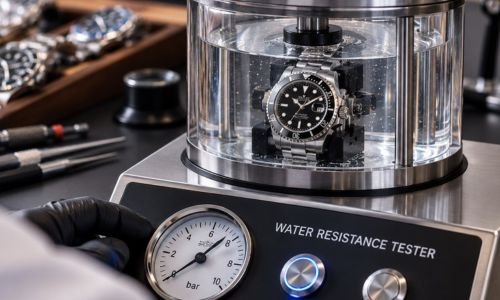
Where appropriate for the watch’s construction and condition, water-resistance testing can help assess the integrity of the repaired case.
A pressure test does not reverse existing movement damage. It is a separate check of the watch’s sealing performance.
Water Damage Repair vs Full Watch Servicing
The correct treatment depends on what inspection reveals.
| Condition | Possible professional work | Main consideration |
|---|---|---|
| Brief internal condensation | Inspection, moisture assessment, seal checks | Whether water reached sensitive components |
| Visible droplets beneath glass | Case opening, controlled drying, internal inspection | Risk of corrosion and contamination |
| Watch stopped after swimming | Movement diagnosis and possible repair | Mechanical or electronic damage |
| Corrosion inside movement | Cleaning, servicing and replacement parts | Extent of component damage |
| Failed case gasket | Seal replacement and suitable testing | Restoring appropriate case protection |
| Extensive salt-water damage | Detailed assessment and repair quotation | Parts availability and repair viability |
A responsible watchmaker should explain the proposed work before proceeding with a substantial repair.
For more background on general maintenance pricing, read our guide to Watch Servicing Cost London.
How Much Does Water Damaged Watch Repair Cost in London?
There is no single reliable price for repairing a water-damaged watch.
The cost depends on the brand, calibre, extent of moisture exposure, affected components and whether replacement parts are available.
For example, a watch with a compromised case gasket but no internal corrosion may need relatively limited work.
A mechanical chronograph with extensive corrosion may require a much more involved service and additional components.
At Dynamis Watch Service Piccadilly, our general full mechanical servicing starts from £150, but that is not a fixed quotation for water-damage repair.
We recommend having the watch examined before deciding on the most appropriate work.
For brand-specific servicing considerations, our Rolex Service Cost UK guide explains why movement complexity, parts and repair requirements can affect the final price.
Can a Water-Damaged Rolex, Omega or Cartier Be Saved?
Sometimes, yes.
The outcome depends less on the name printed on the dial and more on the nature and extent of the damage.
A Rolex, Omega, Cartier, Breitling or TAG Heuer with early moisture ingress may be repairable if it receives attention before significant corrosion develops.
A watch with extensive internal damage can be considerably more difficult to restore.
Vintage watches introduce additional considerations.
Original dials, hands and movement components may be difficult to replace, and preserving their condition may be more important than making the watch look new.
We recommend discussing originality and acceptable replacement parts before authorising restoration work.
If you’re choosing a repairer for a valuable watch, our article How to Choose a Watch Repair Shop in London covers the questions worth asking.
How to Prevent Water Damage in the Future
Water resistance is not a permanent characteristic.
Seals deteriorate through age, wear, environmental exposure and repeated operation of crowns and pushers.
The Japan Clock & Watch Association recommends periodic gasket replacement and warns that water entering a watch can damage its internal mechanism and electronic components.
A few sensible precautions can reduce the risk:
- Have seals inspected as part of appropriate servicing.
- Consider water-resistance testing before swimming or diving, particularly after case-opening work.
- Keep screw-down crowns correctly secured before water exposure.
- Avoid operating crowns or pushers while the watch is wet.
- Avoid hot showers, saunas and steam exposure unless the manufacturer explicitly permits those conditions.
- Have damaged crystals, crowns or case backs assessed promptly.
A watch marked 30 metres, 50 metres or 100 metres should be used according to the manufacturer’s guidance, not simply the number printed on its dial.
Water Damaged Watch Repair Near Piccadilly Circus
If you’ve noticed condensation, unusual timekeeping or another sign of moisture damage, the next step is a professional assessment.
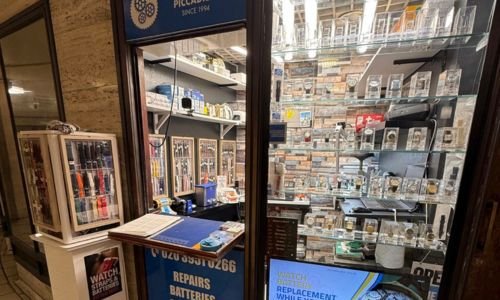
At Dynamis Watch Service Piccadilly, we have been repairing and servicing watches since 1994.
Our workshop is located inside Piccadilly Circus Underground Station, making us accessible from Soho, Mayfair, St James’s, Regent Street and across Central London.
We work with mechanical, automatic, quartz, luxury and vintage watches, including Rolex, Omega, Cartier, TAG Heuer and Breitling.
Walk-ins are welcome during opening hours.
The earlier a water-damaged watch is assessed, the better the opportunity to identify the problem before further deterioration occurs. However, no repair outcome can be guaranteed without inspection.
Frequently Asked Questions
Can a water-damaged watch be repaired?
Many water-damaged watches can be repaired, but the outcome depends on how much moisture entered the case and which components were affected. Early inspection may limit further deterioration. Extensive corrosion, particularly in complicated or vintage movements, can make repairs more difficult or expensive. A watchmaker needs to examine the movement before providing a reliable assessment.
What should I do if my watch has condensation inside?
Remove the watch, keep it away from further moisture and arrange professional inspection promptly. Do not use a hairdryer, place the watch on a radiator or try to open the case yourself. Condensation beneath the crystal may indicate moisture inside the watch, and a clear-looking crystal does not prove that the movement is dry.
Will my watch work again after getting wet?
Possibly, but continued operation does not necessarily mean the watch is undamaged. Moisture can affect lubricants, metal components and electronic circuits before obvious symptoms appear. A watch may run normally for a period and then develop faults. Professional inspection is the safest way to establish its condition.
How long does water damaged watch repair take?
Repair time varies considerably. An initial assessment may identify a straightforward sealing issue, while corrosion inside a mechanical movement may require full servicing and replacement components. Parts availability, movement complexity and the extent of damage all affect turnaround. A watchmaker can provide a more useful estimate after examining the watch.
How much does water damaged watch repair cost in London?
There is no universal fixed price. Costs depend on the watch, movement, affected components and whether cleaning, servicing, seals or replacement parts are required. Dynamis offers general full mechanical servicing from £150, but water-damage repairs require individual assessment. An inspection and quotation will help determine whether the proposed repair is economical.
Visit Dynamis Watch Service Piccadilly
If your watch has been exposed to water and is showing signs of trouble, bring it to our Central London workshop for assessment.
Dynamis Watch Service Piccadilly
Unit 9, Piccadilly Circus Underground Station
London W1J 9HS
Phone: 020 3808 0124
Opening hours: Monday–Friday, 10am–6pm
Walk-ins: Welcome
Guarantee: 12 months on completed work
Learn more through our related guides:
We can examine the watch, discuss the likely repair requirements and explain the available options before substantial work is undertaken.