Looking for watch battery replacement in London and wondering what it should cost, how long it takes or whether your watch will still be water-resistant afterwards? At Dynamis Watch Service Piccadilly, we’ve worked with watches since 1994 from our workshop inside Piccadilly Circus Underground Station, and battery replacement is one of the most common jobs we handle.
A battery change sounds simple. On some watches, it is.
But fitting the correct cell is only part of the job. The case has to be opened without damage, the movement and battery contacts should be checked, and the seals need attention before the watch is closed again.
For water-resistant and luxury quartz watches, that last point is particularly important.
1. How Much Does Watch Battery Replacement Cost in London?
Prices vary considerably across London.
At Dynamis Watch Service Piccadilly, watch battery replacement starts from £20, with many straightforward battery changes completed while you wait.
The final price depends on the watch, battery specification, case construction and whether additional resealing or water-resistance testing is required.
Why do watch battery prices vary?
Not every quartz watch uses the same battery.
Different movements can require different silver-oxide, lithium or specialist cells. Access to the battery also varies considerably between watches.
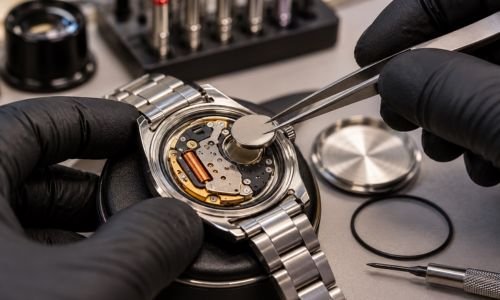
A straightforward snap-back fashion watch is different from a Swiss quartz watch with a screw-down case back, sealing system and specified water-resistance rating.
The condition of the watch matters too.
If we open a case and find a deteriorated gasket, corrosion or evidence of moisture ingress, simply fitting another battery may not be the responsible solution.
Cheap battery replacement isn’t always cheap
You can find very inexpensive watch battery replacement around London.
Price alone doesn’t tell you what is included.
Ask whether the correct battery specification will be fitted, whether the gasket will be inspected, whether the case will be properly resealed and whether water-resistance testing is available where appropriate.
A poorly opened case can be scratched. A damaged or incorrectly seated gasket can compromise the seal.
For a basic inexpensive watch that never goes near water, your priorities may differ from someone bringing in an Omega, Cartier, TAG Heuer or another water-resistant Swiss quartz watch.
2. How Long Does a Watch Battery Replacement Take?
For many watches, you don’t need to leave the watch with a workshop for several days.
At our Central London workshop, straightforward battery replacements can often be completed while you wait, typically in around 10–30 minutes, depending on the watch and how busy the workshop is.
What happens during those 10–30 minutes?
A professional battery replacement involves more than removing one cell and inserting another.
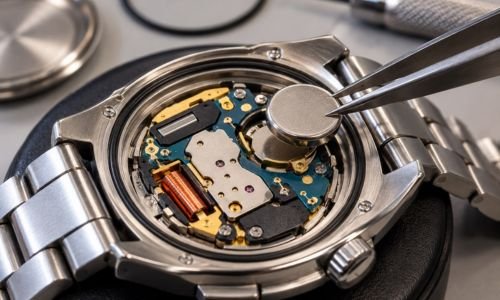
The watch first needs to be opened using tools appropriate to its case-back construction.
The existing battery is removed and its specification identified. The movement and battery contact area can then be visually checked for obvious contamination, leakage or corrosion.
The correct replacement cell is fitted and the watch’s basic operation checked.
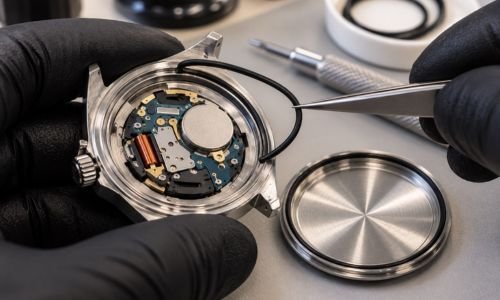
Before the case is closed, the gasket should also be inspected.
Where water resistance matters, resealing and pressure testing may be appropriate before the watch is returned.
When can it take longer?
Some watches require additional attention.
A heavily tightened screw-back, unusual case construction, damaged gasket, corroded battery contact or evidence of moisture ingress can turn a routine battery change into a diagnostic job.
Likewise, if the watch still doesn’t operate correctly with a fresh battery, the battery was probably not the only problem.
The quartz movement may need investigation.
We would rather explain that to you than repeatedly install batteries in a watch with an underlying fault.
3. Watch Battery Replacement London: What Should Be Included?
When comparing watch battery replacement London services, compare the work rather than just the advertised price.
| Service | Basic Battery Swap | Professional Battery Replacement |
|---|---|---|
| Correct battery fitted | Usually | Yes |
| Case opened with appropriate tools | Varies | Yes |
| Battery compartment checked | Varies | Yes |
| Gasket inspected | Often omitted | Yes |
| Gasket reseated correctly | Varies | Yes |
| Replacement gasket if required | Usually extra | Available where required |
| Basic function check | Varies | Yes |
| Water-resistance pressure test | Rarely | Available where appropriate |
| Suitable for valuable watches | Depends on provider | Yes, subject to assessment |
| Dynamis starting price | — | From £20 |
A simple battery replacement may be all a particular watch needs.
The important point is knowing what has actually been done.
What battery should go into your watch?
Battery specification matters.
A watchmaker should identify the cell required by the movement rather than installing whatever physically fits inside the case.
The electrical characteristics and dimensions need to be appropriate for the calibre.
We use suitable quality cells matched to the watch’s requirements.
What if the old battery has leaked?
Don’t ignore battery leakage.
A depleted cell left inside a watch for a long period can leak and damage the battery contacts or movement.
That turns an inexpensive maintenance job into a potential repair.
If your quartz watch has stopped, don’t leave the dead battery inside indefinitely.
Bring it in for inspection even if you aren’t currently wearing the watch.
4. Will My Watch Still Be Water-Resistant After a Battery Change?
This is one of the most important questions to ask when having a battery replaced.
Do not assume a watch remains water-resistant simply because the case back has been closed again.
Opening the case disturbs the sealing system.
The gasket matters
Most water-resistant watch cases rely on seals or gaskets at vulnerable points.
Depending on the watch, these can include seals around the case back, crown, crystal and chronograph pushers.
Gaskets don’t last forever.
They can harden, flatten, crack or deteriorate with age, temperature changes, chemicals and ordinary use.
If the case-back gasket isn’t correctly positioned when the watch is closed, its ability to resist moisture can be compromised.
This is why we inspect the seal during battery replacement and reseal the watch appropriately.
Water resistance isn’t permanent
A rating engraved on the case back describes the watch’s intended resistance under specified conditions. It isn’t a lifetime guarantee.
Seals age.
Crowns can be damaged. Crystals can receive impacts. Cases can deform. Previous repairs can also affect sealing surfaces.
If you regularly swim with your watch or rely on its water resistance, periodic testing is sensible.
Why pressure testing matters
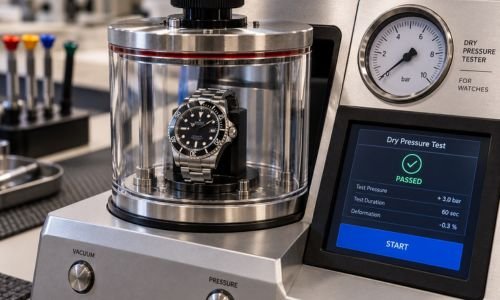
A professional pressure test helps establish whether the closed watch is sealing correctly.
Dry pressure testing can evaluate case deformation under controlled pressure without immersing the watch in water.
Depending on the watch and service required, other testing methods may also be used.
This provides considerably more information than looking at a gasket and assuming everything is fine.
For watches routinely exposed to water, pressure testing is particularly valuable after the case has been opened.
5. Does Every Watch Need Pressure Testing After a Battery Change?
Not necessarily.
The appropriate level of service depends on the watch and how you use it.
Everyday dress and fashion watches
If a watch isn’t intended for swimming and has little meaningful water-resistance requirement, a straightforward battery replacement and seal inspection may be sufficient.
That doesn’t mean you should deliberately expose it to water afterwards.
“Water-resistant” and “safe for swimming” are not interchangeable descriptions.
Luxury quartz watches
For a luxury quartz watch designed with meaningful water resistance, testing deserves more attention.
Brands such as Omega, TAG Heuer, Breitling, Cartier, Longines and others have produced quartz watches with varying case constructions and water-resistance ratings.
Opening one purely to change the battery shouldn’t mean ignoring the rest of the case.
The battery is inexpensive compared with the potential cost of repairing a movement damaged by moisture.
Diving and sports watches
If you swim or dive with the watch, pressure testing becomes more important.
A diving watch may look perfectly sealed from the outside while an ageing gasket or crown seal is no longer performing correctly.
Manufacturer guidance also supports this caution: major Swiss watch brands note that water resistance isn’t permanent because gaskets age and sealing components can be affected by impacts.
If the watch is used regularly in water, treat water resistance as something that needs maintaining and verifying rather than assuming.
6. Why Did My Watch Stop If the Battery Isn’t Dead?
A stopped quartz watch often needs a battery.
Often — not always.
Movement problems
Quartz movements still contain mechanical components.
The battery supplies energy, but the movement must convert that energy into controlled motion.
A fault in the electronic circuit, coil, stepper motor, gear train or battery contact can stop the watch even when the battery itself is healthy.
Old lubricants, contamination and corrosion can also cause problems.
Moisture ingress
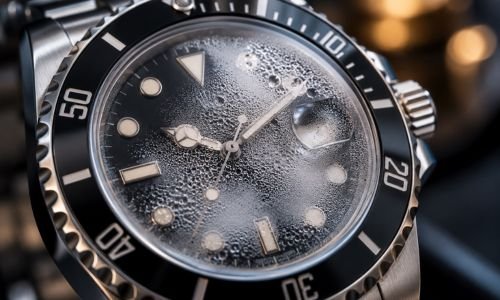
Condensation beneath the crystal is a warning sign.
Water inside a watch can damage electronic and metallic components quickly.
If you see mist or droplets beneath the glass, don’t wait for the next convenient battery change.
Have the watch inspected.
Battery contact problems
The battery must make reliable electrical contact with the movement.
Corrosion, contamination or a damaged contact can interrupt the circuit.
Installing another battery without identifying the underlying problem may achieve nothing.
A fresh battery but the watch still stops
If a new battery has recently been fitted and the watch stops again, don’t automatically assume you’ve received another bad battery.
The movement may be drawing excessive current or suffering from a mechanical or electrical fault.
That needs diagnosis rather than another battery swap.
7. Should You Replace a Watch Battery Yourself?
Technically, many quartz watch batteries can be changed at home.
Whether you should do it is a different question.
Opening the case with an inappropriate tool can scratch the case back, slip against the lugs or damage the opening point.
Inside the watch, careless handling can damage the battery contact, movement or gasket.
The biggest limitation is what happens afterwards.
You may be able to close the case, but without appropriate testing equipment you cannot reliably verify the watch’s water resistance.
If you’re interested in the technical process, read our guide to replacing a watch battery without damaging the seals. It explains the tools, gasket handling and risks involved.
For an inexpensive watch with no meaningful water-resistance requirement, some owners are comfortable changing the cell themselves.
For a valuable, sentimental, vintage or water-resistant watch, professional handling is usually the safer option.
8. When Should You Replace Your Watch Battery?
There is no universal battery interval suitable for every quartz watch.
Battery life depends on the movement, battery specification, functions and power consumption.
A simple analogue quartz watch and a multifunction quartz chronograph can have very different energy requirements.
Don’t wait indefinitely after the watch stops
Once a quartz watch stops, arrange a battery replacement rather than storing it for years with the depleted cell installed.
Battery deterioration and leakage can damage the movement.
TAG Heuer, for example, specifically advises owners to replace the battery promptly when a quartz watch stops because a defective battery can damage the mechanism.
Watch for end-of-life indicators
Some quartz movements have an end-of-life indication.
Rather than ticking normally once per second, the seconds hand may begin advancing in larger intervals.
This can indicate that the battery is nearing the end of its useful life while the watch continues to keep time temporarily.
The exact behaviour depends on the movement.
If your watch starts behaving differently, bring it in and we can check it.

Visit Us at Piccadilly Circus
If you need watch battery replacement in London, you don’t necessarily need to send your watch away or wait several days.
Dynamis Watch Service Piccadilly has been repairing watches since 1994, and our workshop is located directly inside Piccadilly Circus Underground Station.
Battery replacement starts from £20, and many straightforward jobs can be completed while you wait.
Where appropriate, we can also inspect the seals, reseal the case and carry out water-resistance pressure testing.
We’re particularly convenient for customers working, shopping or travelling through Piccadilly Circus, Mayfair, Soho, St James’s, Regent Street and Central London.
Dynamis Watch Service Piccadilly
Address: Unit 9, Piccadilly Circus Underground Station, London W1J 9HS
Telephone: +44 203 808 0124
Opening hours: Monday–Friday, 10am–6pm
Walk-ins: Welcome
Battery replacement: From £20
Guarantee: 12 months on our work
Bring your watch to the workshop and we’ll inspect it before proceeding. If the problem is more than a depleted battery, we’ll explain what we’ve found rather than treating every stopped quartz watch as a simple battery change.
Watch Battery Replacement Piccadilly — See our dedicated battery replacement service and what the process includes.
Watch Servicing Cost London — Compare battery replacement, mechanical servicing and other common watch maintenance costs.
Contact Dynamis Watch Service Piccadilly — Find our Central London workshop and contact details.
Frequently Asked Questions
How much does watch battery replacement cost in London?
Watch battery replacement prices depend on the watch, battery specification and whether resealing or pressure testing is required. At Dynamis Watch Service Piccadilly, battery replacement starts from £20. We inspect the watch first and can explain if it requires anything beyond a straightforward battery change.
How long does a watch battery replacement take?
Many straightforward battery replacements can be completed while you wait, often in approximately 10–30 minutes. Watches requiring gasket replacement, pressure testing, investigation of corrosion or movement diagnosis can take longer. At our Piccadilly Circus workshop, we’ll give you a realistic timeframe after seeing the watch.
Should a watch be pressure tested after battery replacement?
If the watch has a meaningful water-resistance rating or is regularly used in water, pressure testing is sensible after the case has been opened and resealed. Water resistance depends on the condition of gaskets, crown, crystal and other sealing components. A closed case alone doesn’t prove that the watch remains water-resistant.
Why isn’t my watch working after replacing the battery?
The battery may not have been the underlying problem. Quartz watches can stop because of damaged battery contacts, corrosion, moisture ingress, electronic faults or problems within the gear train or stepper motor. If a correctly specified fresh battery doesn’t restore normal operation, the movement should be professionally diagnosed.
Can I walk in for watch battery replacement at Piccadilly Circus?
Yes. Walk-ins are welcome at Dynamis Watch Service Piccadilly from 10am to 6pm, Monday to Friday. We’re at Unit 9 inside Piccadilly Circus Underground Station, London W1J 9HS. Many straightforward battery replacements are completed while you wait, so no appointment is normally necessary.